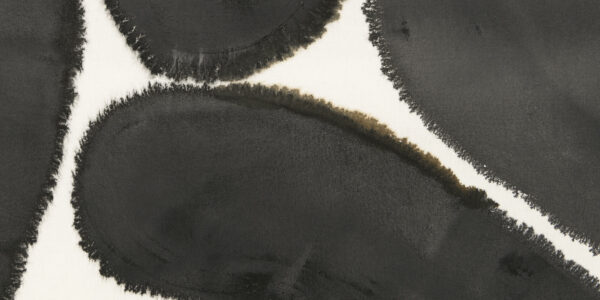
The breeze blows gently, making more and more noise on the foliage. This heavy noise becomes unbearable. Put the hands to the ears and run away, 2019
Latifa Echakhch
‘[The Albatros] is beautiful in the sky, but in the world, on
the ground, it looks ridiculous. And I felt like it, in a way…
It’s really the figure of the artist. We have the superability of
feeling, but on the ground we are disabled, we are too
sensitive.’ - Latifa Echakhch
The large-scale paintings of visual artist Latifa Echakhch show black shapes evoking both microscopic growths and strange, uncanny rhizomes. Applied to very damp canvases, the black India and sepia ink spread as it was absorbed, creating unpredictable contours that resist control. Though simple in form, these vibrating tendrils seem to have a tactile quality and an intense liveliness to them, pulling us into a state of quiet melancholy.
This landscape, generated through a relatively minimal visual language, gains another layer through the elaborate titles of poetic quality. They engage not only our tactile sense - feeling a breeze blowing- but also sharpens our auditory faculties as we imagine the noise of foliage becoming unbearable. In Echakhch’s work, image and text collaborate to encourage and favour a bodily over a cerebral encounter with the work, connecting inner and outer landscapes.
2019, black India ink and sepia ink on canvas, 200 x 150 cm
Courtesy of the artist and DVIR Gallery

Latifa Echakhch
°1974, El Khnansa, Morocco
Working in painting, sculpture and installations, Latifa Echakhch’s practice is both conceptual and romantic, political and poetic. Her practice is aimed at questioning as well as feeling the world around her, and translating these sensitivities into objects and installations in order to make them readable and shareable. Her work has been presented in France and abroad in numerous solo exhibitions: at Kunsthaus in Zurich, Switzerland; the Centre Pompidou in Paris; the macLYON in Lyon; the Hammer Museum in Los Angeles; MACBA in Barcelona; FRI ART in Fribourg; Frac Champagne-Ardenne in Reims, France; Swiss Institute in New York; Tate Modern in London; Le Magasin in Grenoble; KIOSK in Ghent, Belgium; the New National Museum of Monaco; the Memmo Foundation in Rome, Italy; Kunsthalle Mainz, Germany; BPS22, in Charleroi, Belgium; as well as group exhibitions and as part of the Istanbul Biennial, the 54th Venice Biennial, the 11th Sharjah Biennial, the Jerusalem Art Focus Biennial and the Manifesta 7 in Bolzano. She won the Marcel Duchamp Prize (2013), the Zurich Art Prize (2015), represented Switzerland at the 59th Venice Biennale (2022), and was the invited artist of the Messeplatz Project, for Art Basel, Basel, 2023.
Latifa Echakhch lives and works between Martigny and Vevey, Switzerland, and is represented by DVIR Gallery, Pace Gallery, kaufmann repetto, and Galerija Kula.